My Journey as an Amateur Photographer Thus Far
August 7, 2026
Tags: Photography, Film Photography

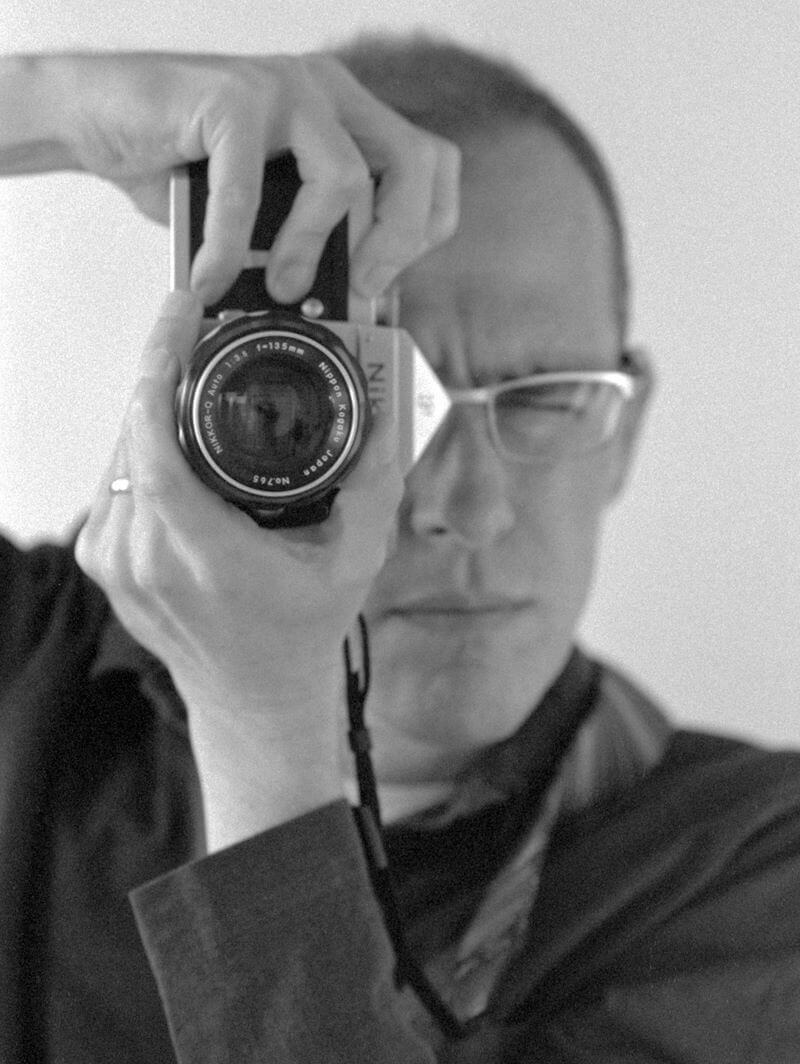
About five years ago, I began taking my practice of photography more seriously. A lot has happened since the summer of 2021.
To be sure, that point in time doesn’t represent some cold starting point for me. I had been taking photographs since I was 17, when I got my first camera that I could meaningfully call my own, an Olympus Stylus Zoom which is sadly no longer in my possession. But there were certain milestones that I passed about five years ago that marked the fact that I was no longer simply taking thoughtless snapshots.
Those first milestones didn’t seem all that significant at the time. In August 2021, I checked out a copy of Ben Long’s Complete Digital Photography from my local library. More than anything else I had encountered up to that point, that book walked me through the basic concepts of photography and the way most digital cameras implement them. I started to understand how to do photography in a way I hadn’t before.
That same month, I began exploring new possibilities offered by different lenses. Getting my hands on a Praktina-to-Canon EF-M lens adapter allowed me use an old set of 35, 58, and 135mm lenses on my Canon EOS M200 camera, which at the time was my only camera. I had acquired those lenses with a non-functional Praktina FX camera I bought a few years prior but never used or got serviced. I also purchased a new and relatively inexpensive Meike 35mm f/1.7 lens. The all-manual focus and aperture rings on all of these lenses forced me to put more thought into where to place focus and to what degree I could use depth of focus to emphasize my subject. Prior to that, my camera and 15-45mm kit lens combo had been shielding me from such considerations. No longer was I limited to what my auto-everything gear offered me.
In September 2021, I went on my first photo walk, which is to say that, for the first time, I stepped out of the house with a modestly serious camera in hand with the express intent to do photography. Although at the time I was unaware even of the genre’s existence, those first photo walks marked my beginning as a street photographer. It’s fun now to look at the images that came out of them. I can see how I was just starting to feel out photography more thoughtfully.
The next month, I bought a used Canon EOS M50. As I sank deeper into middle age, I found it harder and harder for my eyes to focus on things close to me with my glasses on. Not long after getting my M200, I started having trouble seeing its back viewscreen clearly. But with my new (to me) M50, I had a small yet nimble camera with a proper viewfinder that I could use with my glasses on. Although my Canon EOS R8 is my current digital workhorse, I continue to feel a little sentimental about my little M50. Besides, it still makes a great travel camera.
One’s skill as a photographer and one’s expressiveness as an artist isn’t a function of one’s choice of gear. But the tools and media that one uses as a photographer certainly has an effect on how one expresses oneself artistically. At this stage, I am far more enthusiastic about what I can do by shooting black and white film and making my own prints using my simple home darkroom setup than what I am able to accomplish by shooting a digital camera and rendering images on a coldly glowing screen. But I didn’t always feel that way. When did I make the transition?
Ironically it’s computer technology that helps me shed light on this question. Since I use and maintain my own custom-built database application to manage my photography, getting that answer is easy. Here’s a quick-and-dirty summary that I whipped up in Excel of the number of solitary photo walks I’ve done around my hometown and what kind of camera I used during those walks:
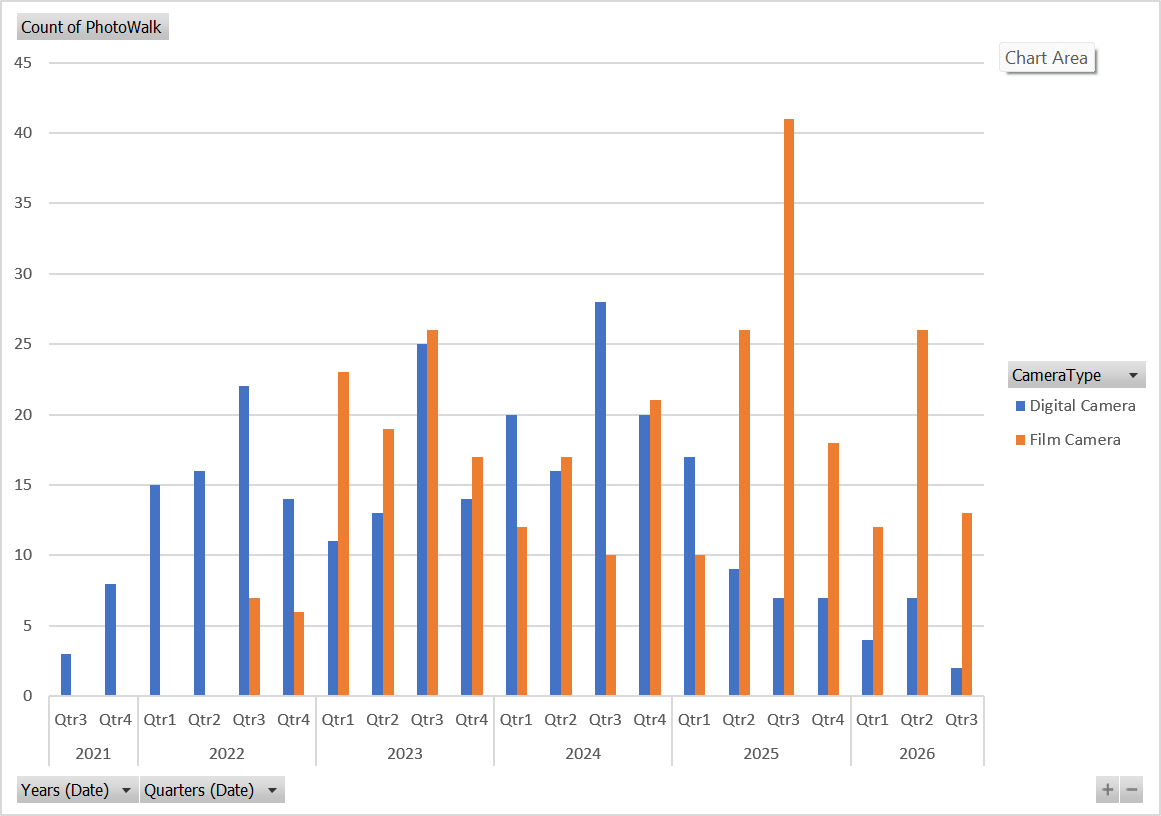
In 2021 and the first half of 2022, I reached exclusively for a digital camera. After I bought my first Nikon F camera body in the summer of 2022, I began using film for the first time in twenty years. For the most part over the next few years, I used digital and film cameras fairly evenly. It was only after I started developing my own film in March 2025 and making my own black and white darkroom prints a few months later that I shifted decisively to using black and white film at least for local photo walks. Most often it’s out of laziness that I’ll grab a digital camera.
When film photography was new to me again, I went through an intense process of trying out a wide variety of film stocks, and my data shows that. Here is a summary of the number of film rolls I’ve shot by film stock each year:
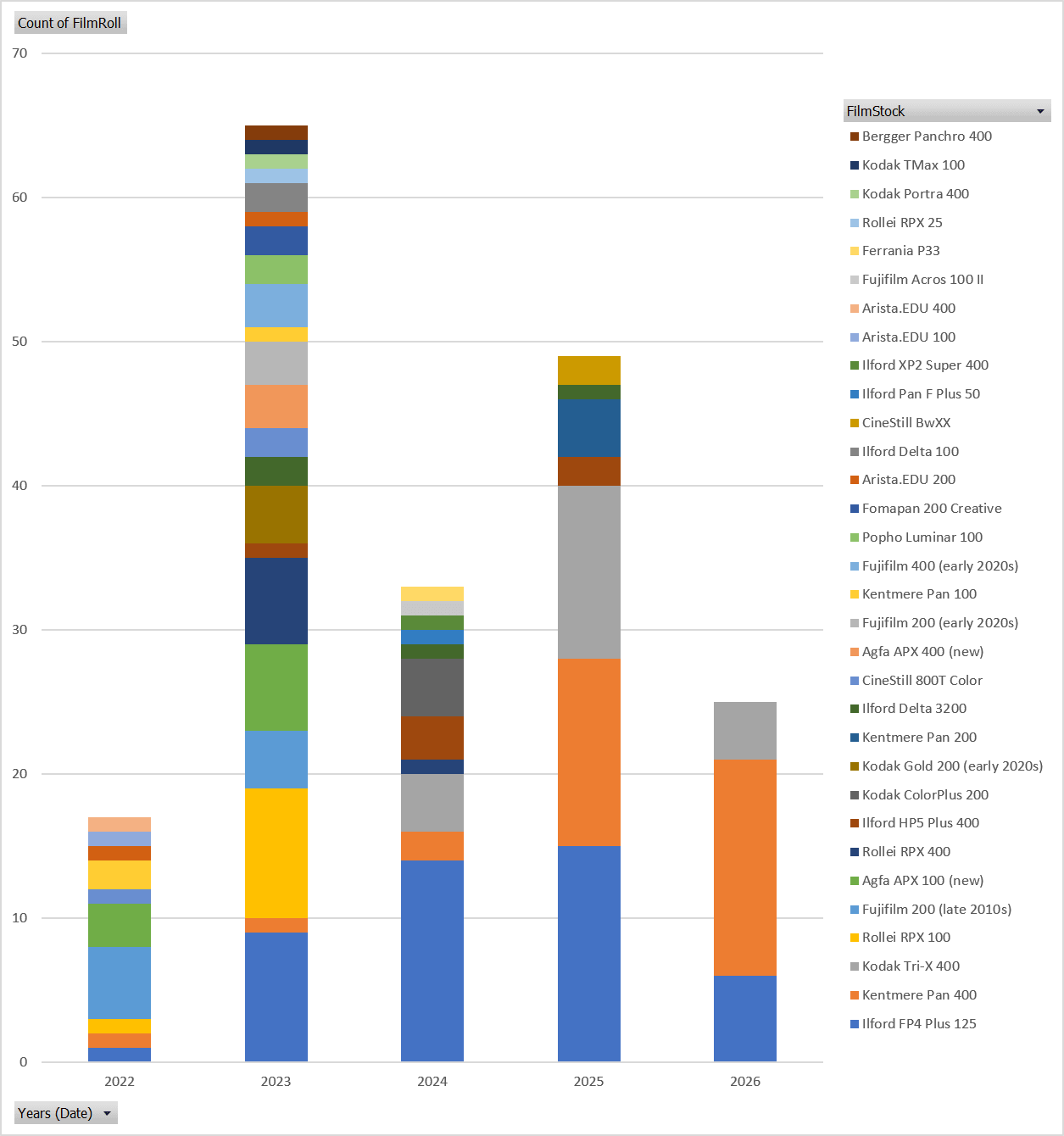
Especially in 2023, I was all over the place. Although I shot a lot of slower black and white film, most notably Ilford FP4 Plus, Rollei RPX 100, and the new branding of Agfa APX 100, I tried anything and everything both color and black and white. In 2024 and especially 2025, I started to gravitate toward Ilford FP4 Plus, Kodak Tri-X 400, and Kentmere Pan 400.
It seems I’ve landed on Kentmere Pan 400 as my bread-and-butter film stock. Especially in darkroom prints, I love its wonderful balance of whites, blacks, and grey tones. Its grittiness is just enough to be there in a pleasing way without being overwhelming. And it’s affordable! Especially when I’m experimenting, shooting on a cheaper yet high-quality film stock like Kentmere Pan 400 actually greases the creative wheels. When I shoot pricier film, I feel more inhibited when I know that my per-frame costs are significantly higher. My creativity suffers as a result.
Having good tools to use is important, but I fully know that a certain kind of camera, lens, or film stock won’t make me a better photographer. If there’s one thing I’ve learned these past five years, it’s that finding my voice as an artist is both the most important and the most difficult thing of all. Getting a little dopamine rush every time I feel and hear the shutter of my Nikon F go ka-chick is great, but getting out and shooting random subjects doesn’t lead to a very compelling body of work. What am I trying to say with my photography? Answering that question has been the biggest challenge of all. Every serious photographer ought to grapple with that problem.
I completely agree with David Gibson. In his exceptionally well-written Street Photographer’s Manual, he argues that books—not Instagram feeds or any number of websites but rather books, real physical books—are the best sources of inspiration, and they are the most respectful to the photographer. They show what’s possible with the medium in a way that is far superior to looking at a photograph on a device.
At first, the kind of photography books that I bought were how-to manuals and books about stuff. In my first year as a serious amateur photographer, I bought a copy of John Wade’s Retro Camera, Todd Gustavson’s 500 Cameras, Andreas Feininger’s, The Complete Photographer, and Roger Hicks’s A History of the 35mm Still Camera. To this collection a year later, I added Keppler on the Eye Level Reflex by Herbert Keppler of Modern Photography fame and Peter Braczko’s The Complete Nikon System. All of them are interesting books. But for the most part (Feininger’s book being the exception), they are not great sources of inspiration or thoughtfulness. My feeling about them underscores how little interest I have in collecting shelf queens.
Although I have no shortage of books about stuff, I don’t reach for them terribly often these days. When I’m looking to be moved by beauty or provoked by a visual comment, I reach for one of my photography monographs. If my memory serves me, my first proper photography book was Robert Frank’s The Americans, which I bought in July 2022. To his credit, the guy at the Leica Store in San Francisco who rang it up for me commented that it was a great way to start building my collection. Later, I bought a copy of John Humble’s A Place in the Sun after a chance street encounter with the photographer himself in Santa Monica. Next to end up on my shelf were Pete Souza’s The West Wing and Beyond and Peter Lindbergh’s On Fashion Photography. All are interesting titles, and I still look through most of them regularly. But put together, they represent a smattering of this and that.
It was in the summer of 2023 that I really started to focus my attention on acquiring books about street/documentary photography especially from the 1950s and 60s. I bought a copy of Clément Chéroux’s concise biography on Henri Cartier-Bresson, Ernst Haas: New York in Color, 1952-1962, Magnum Contact Sheets, Elliott Erwitt’s Paris, Saul Leiter: The Centennial Retrospective, Forever Saul Leiter, The Unseen Saul Leiter, Fred Herzog: Black and White, and Fred Herzog: Modern Color. I have invested in many other such books since then, and I page through them all regularly. They are worth far more to me than a big collection of beautiful cameras and lenses that rarely get used. I’ve become stingy with buying photography gear; with books, I’m profligate.
About this time last year, I also realized the importance of having an understanding of the history of photography and particularly the kind that speaks loudest to me. Partly as an outgrowth of my collection of photography books, making the effort to articulate and write about my favorite photographers helped me develop a stronger critical eye. The exercise surely has had an effect on my own work, such as it is. (That’s to say with humility that I’m not ranking myself up there with the greats. Rather, my understanding of the development of photography as an art form has helped me to find my own voice.)
So where are all of these photographs of mine? I confess that I’ve been sharing them less and less online. For more than a decade now and due to a variety of motives—you don’t have to look hard for myriad reasons why it’s awful not just for kids but for all of us—I have been absent from social media. My reply to the question, “What’s your Instagram?” with, “I’m actually not on social media,” often earns me surprised or confused looks. Many don’t know what to do with that response. And I feel like a dinosaur. It’s as if we’ve collectively lost basic social skills that aren’t tied in with shoveling all manner of details about our lives into some kind of online juggernaut all for the profit of a bunch of tech jerks. Remember, where social media is concerned, you are the product they have monetized.
Put it this way: everyone it seems does social media, but no one feels great about it. And yet few do anything to make a real change. Or another way: many seem driven to do photography not for the love of the art but instead out of a compulsion to feed an infinite scroll and gain recognition. The vanity of it all turns my stomach.
With certain exceptions, I’ve also been pulling back from sharing my photography on this website. Over the course of these past three years or so, seeing the rise of artificial intelligence has had a rather profound effect on my willingness to post anything on the internet. I am disgusted by the degree to which automated AI crawlers are surely vacuuming up content (now there’s a heartless term I’ve come to disdain) all so that some energy-hungry machine can do the thinking for us. Although I continue to enjoy writing for the web, I’ve been doing so less, and I’ve been limiting myself mostly to technical themes. At the same time, I’ve been more and more protective of my actual photographic work, and I’ve been increasingly reluctant for it to touch the internet. My film photography prints, which I’ve come to feel are far superior to any kind of digital rendering, are safely sequestered as physical objects that can’t be put on the internet. When I do post something, I have this sinking feeling that all I’m doing is training some AI engine. The whole thing is utterly appalling. Frankly I’m resigned with disappointment over the overall absence of pushback against AI. Maybe there’s a reckoning that coming. Or maybe not. Who knows?
So that’s been my photographic journey over the past five years. Gear is important but not paramount. Physical things—film negatives, prints, real books—are far better than digital ones. Put the device aside and give social media a break! And accumulating gear that may be fun to buy and unbox but gets seldom used should never outweigh coming to an understanding of what one has to say through one’s photography and the real experiences one gains by pursuing it. It’s not about the camera. It’s what you do with it that counts.
I wonder what these next five years will bring me.